
Project Title:
MiLIGA
Project Type:
Personal Project
Project Date:
Ongoing
Team Members:
Jesus Jimenez
My Role:
UI/UX Designer
Tools:
Figma
Illustrator
Photoshop
MiLIGA: Where Soccer Teams Connect
PROJECT SUMMARY
This app allows soccer teams to have a personal messaging system. However, while working on this project, I discovered that soccer teams do not exist by themselves. They are part of a larger community. That being an entire league, and although interested in their teammates, soccer players also want to be able to see and communicate with this larger community.
THE CHALLENGE
I began focusing on what could be a problem recreational soccer teams face. Quickly I saw that time and time again, soccer coaches had a big problem:
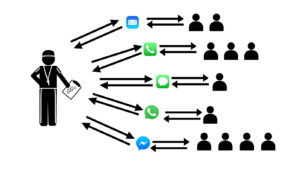
Soccer coaches from recreational soccer leagues have a hard time communicating with their players because they are using various channels of communication.
THE SOLUTION
Design a messaging system that enables soccer coaches to message their entire team from one place.

THE PROCESS

Empathize and Research
Understanding the users
I learned that most players are using two or more messaging systems to communication with their coach and team. That makes any dialogue within the team difficult because it fragments a conversation. There is no one point of resource to view an entire conversation.
Coaches have an extra difficulty because they have to jump from app to app to send the same message to different players and also rely on some players to rely on a piece of information to other players.
Also that most players play year-round because a season usually lasts six months. That they really care about winning and their health.
Surveys:
-
- Players play to stay healthy and relieve stress
- Players have two uniforms
- Players have two pairs of shoes
- They participate in two seasons per year
- Players are spending ~$150.00 per season in fees and equipment
- The top modes of communication are text messages, Facebook, and phone calls
- Average age 25-35
Interviews:
-
- Would like a team stats page
- Would like to have a community section
- Some users were wondering if they could connect it with their online soccer teams like FIFA games
Non-participant Observations:
I observed some soccer games by sitting off to the side with other spectators. My main observations were:
-
- I noticed that coaches would be the first to arrive.
- If most of their team did not arrive after a few minutes after them, they would look at their phone repeatedly and sometimes make calls. I assume it was to communicate with the players who hadn’t arrived.
- As players arrived the coach would ask, Where is so and so?
- As the kick-off time got closer and some teammates seemed to be missing, some players would also pull out their phones to make a call or send a text message. Sometimes you can hear a player scream where is this player or that player.
Market Research
I decided to look at the market to see who is playing in adult recreational sports leagues and to understand how big the market is.
-
- One in four adults (25%) currently play sports, and a half (50%) of adults who play sports report playing every day or a few times a week
- The top five sports played most often by adults overall are golf, basketball, baseball/softball, soccer, and running or track
- The top five sports played by men most often (including ties) are golf, basketball, soccer, baseball/softball, football, and running or track
- The top five sports played by women most often are running or track, baseball/softball, tennis, volleyball, and swimming
- (55%)of adults who play sports do so for personal enjoyment while almost one in four (23%) of those who play do so for health-related reasons
- (85%) say their performance is important to them
Source: NPR/Robert Wood Johnson Foundation/Harvard T.H. Chan School of Public Health, Sports and Health in America
Adults’ Participation in Sports by Age |
|
| % saying played any sports in the past year | |
| Ages 18-21 | 40% |
| Ages 22-25 | 41% |
| Ages 26-29 | 26% |
| Ages 30-49 | 26% |
| Ages 50-64 | 20% |
| Ages 65+ | 19% |
| NPR/Robert Wood Johnson Foundation/Harvard T.H. Chan School of Public Health, Sports and Health in America, January 29 – March 8, 2015. Total N = 2506 adults | |
Competition
I noticed that the competition allows users to communicate via other means outside their apps.
But I feel that coaches need the entire team to use the same system and not various, to more easily communicate with them. Also, most do not have a space for the team to talk to one another like a group chat.
Competitor’s Messaging Options |
|||
| TeamSnap | Teamer | Team Pages | |
| Personal Messages | No | No | Yes |
| Emails | Yes | Yes | No |
| Text Messages via app | Yes | Yes | No |
| Team Chat | Yes | Yes | No |
Define
In this stage, I began to focus on what problem I was going to solve and for whom. What I discovered was, that busy soccer coaches need a way to communicate with 20+ people at once. So I decided to focus on a solution that would help soccer coaches communicate easily with their teams.
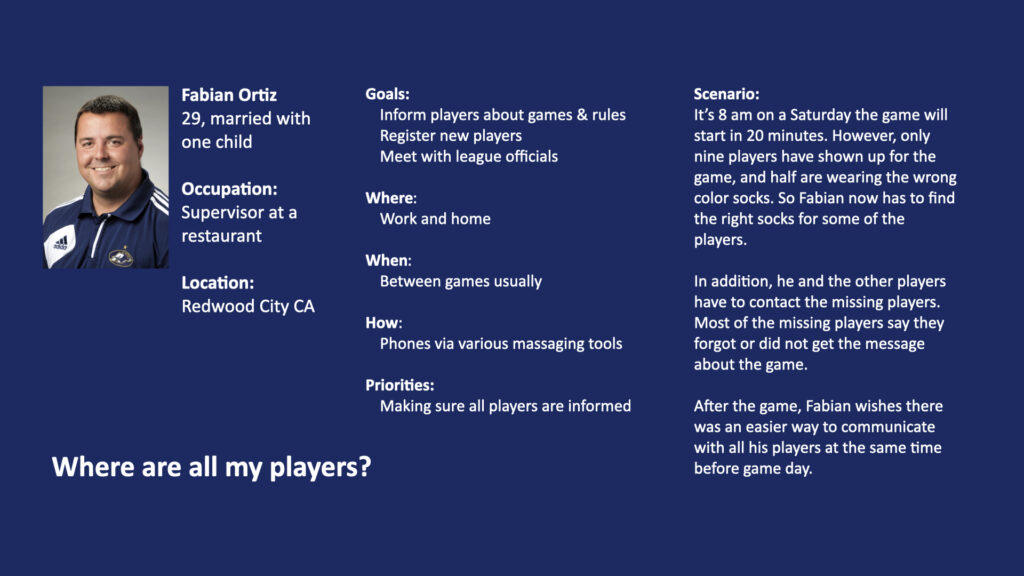
Fabian is a soccer coach from a recreational soccer league who needs a way to send one message to all his players at once because he does not have time to send the same message multiple times through different systems.
Persona: Fabian the Coach
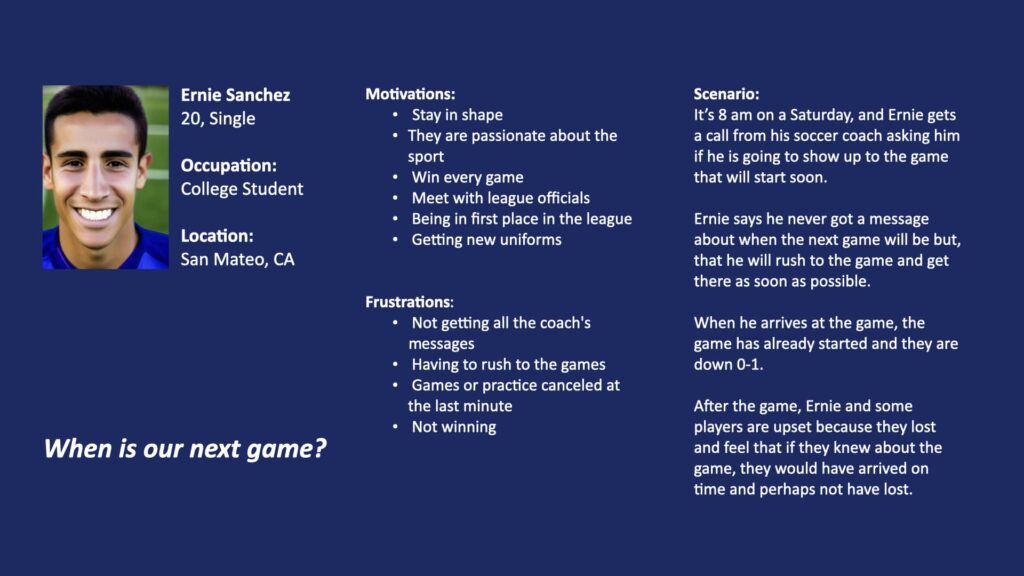
Persona: Ernie the Soccer Player
Ideation
I decided that the problem to solve was the problem soccer coaches faced every time they wanted to send a message to the entire team. The solution was going to be a self-contained messaging system that allowed coaches to send one message to multiple people at once.
Minimum Viable Product (MVP)
As this was going to be the first iteration, I also considered the main features this product needed before launch that could help our users the most, the MVP.
For the MVP I identified that the main feature needed was the option for the user to be able to communicate with the entire team. So a group chat button needed to be easy and quick to access.
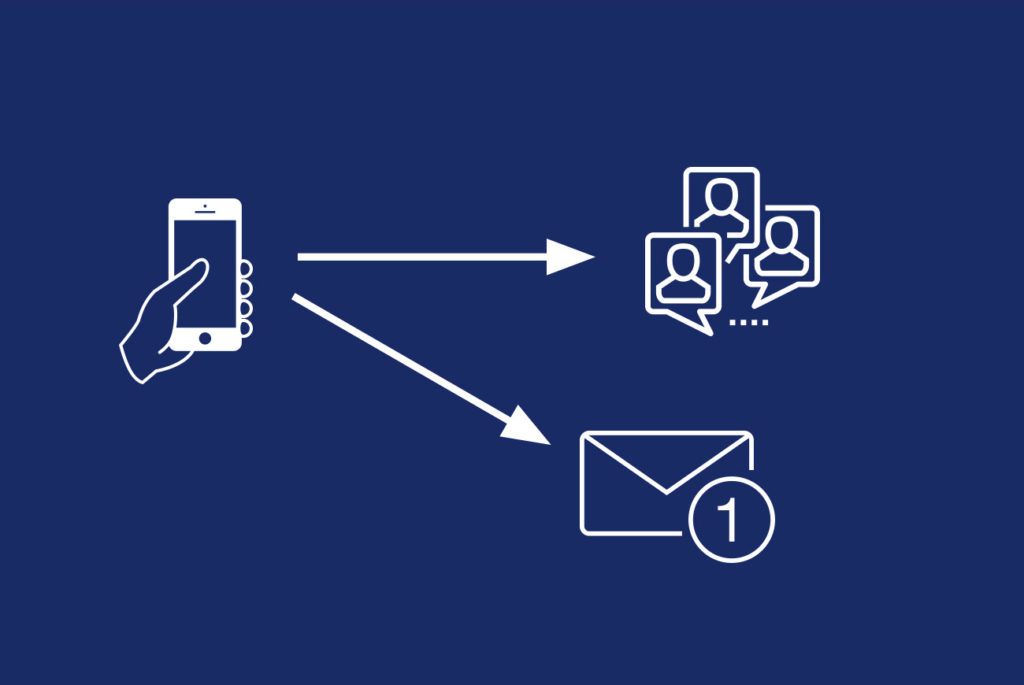
Afterward, I moved on to the next stage, which was to build such a system.
Prototypes and Testing
Lo-fi Prototype and Testing
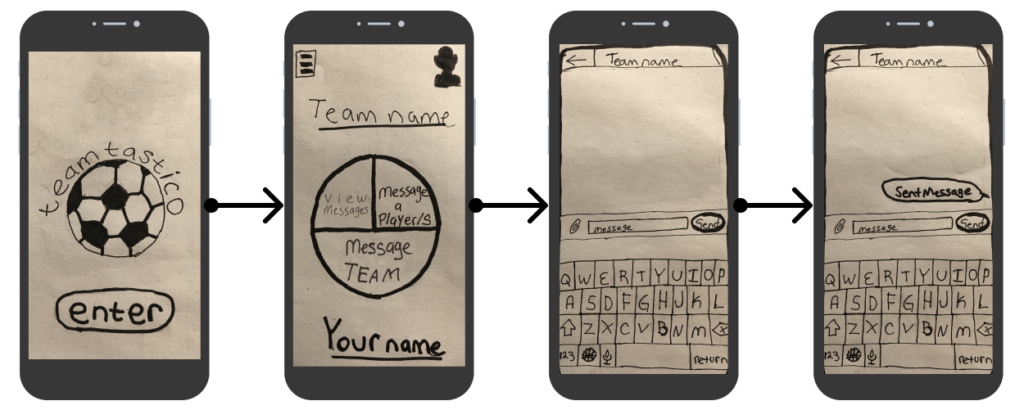
In the first set of wireframes, I placed a navigation system in the center of the screen, but after testing those screens with users, I learned that people expect a navigation system at the top or bottom of the screen.
Placing the navigation as a circle in the center of the screen confused people because they did not understand that it was a navigation menu or how it functioned. Some users thought it was a logo.
So in the final prototype, I placed the navigation system at the bottom, so users wouldn’t have a problem locating it.
User flow
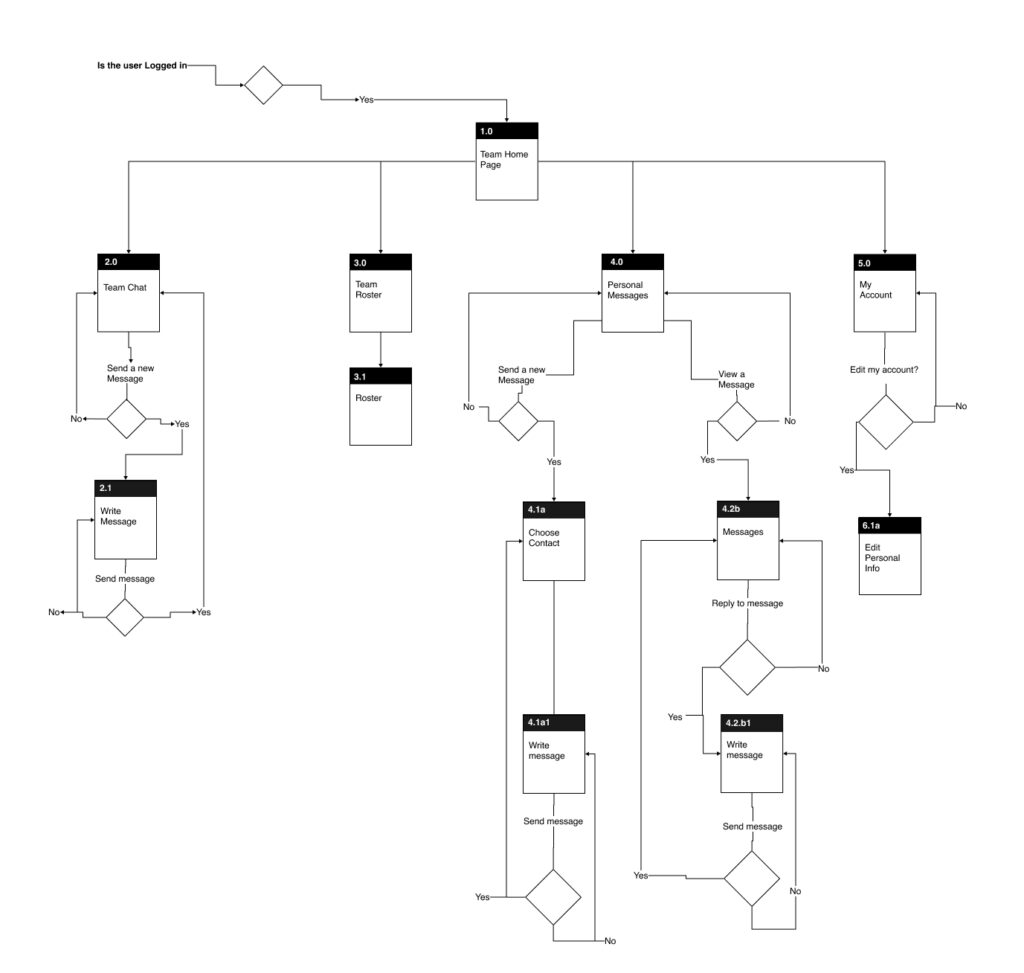
When thinking about our primary target audience, soccer coaches, they need to have access to sending a message to the entire team as soon as they enter the app. So the user flow focuses on the steps a coach will need to take to send a message.
Moodboard
Speed
Boldness
Intensity
After working on the wireframes and getting feedback from users, it was time to think about the UI of the app. So I started looking for inspiration to define a color palette and fonts. I wanted colors and fonts that could reflect some of the characteristics of soccer. Such as speed, boldness, and intensity.
From start to finish soccer games are pretty much non-stop. So the color combination I chose captures the energy you will need to be able to play non-stop.

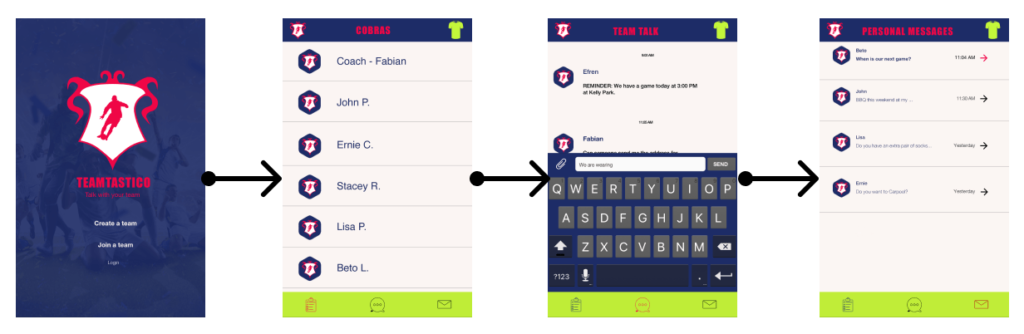
Mid-fi Prototype and Testing
When I tested the Mid-fi prototype, I learned about other features players would like to see. Overall they liked the idea of having access to message everyone on the team or even individual players. However, they felt that just having a system to send messages lacked other things a team needed and wanted.
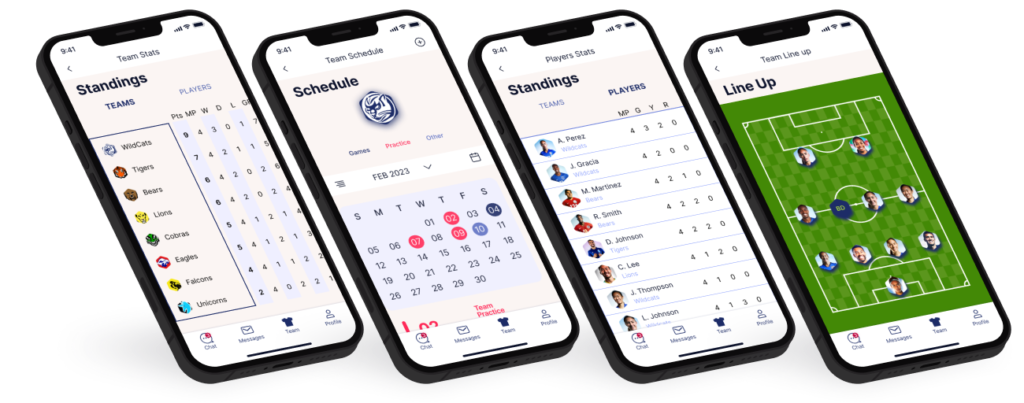
Players mentioned that having a team stats page would be great to see how they were performing in the season. Coaches wanted a place to show a line-up before games and a way to create a schedule for the team.
Additionally, they were all interested in seeing a league score table and other information about the other teams from the league.
Next Steps
The next steps for this project are to build and test additional screens with the features mentioned by players and coaches, such as a stats page, team lineup, schedule, and league table.
Additionally, the name ‘TeamTastico’ used in the lo-fi prototype might not fully capture the concept of the entire league, so the name ‘MiLIGA’ will be tested in the next rounds as it reflects the entire league and not just the team.
After testing the new features and gathering feedback, I hope to build the app and make it available to a broader audience to assess the level of interest in using this type of app within soccer teams.
See the latest prototype below.