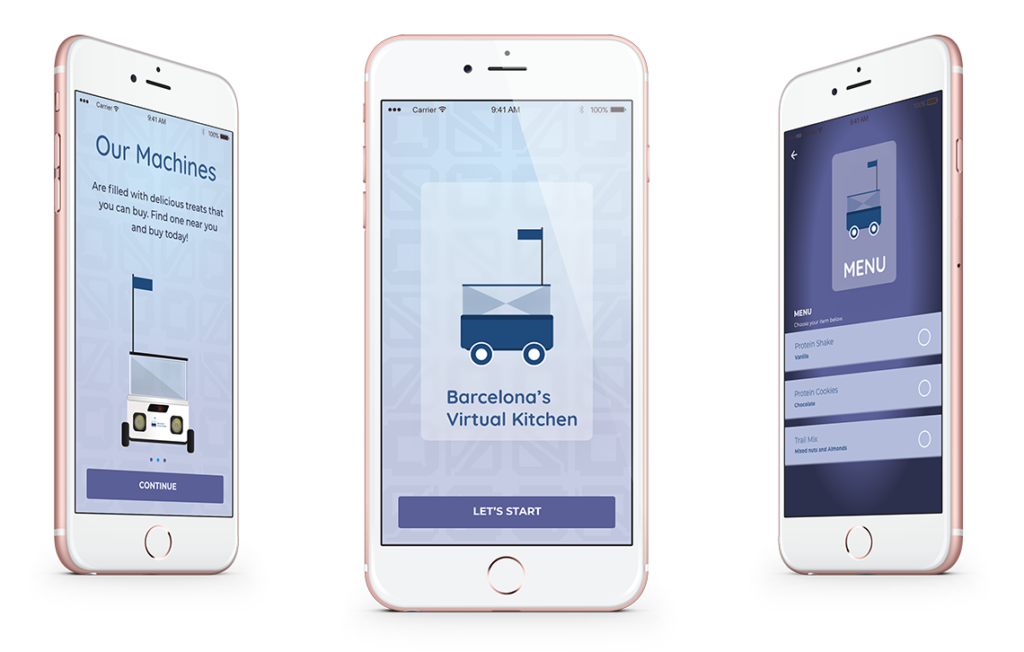
[callout]Introducing the future of snacking in Barcelona – we are a revolutionary mobile vending machine company that is bringing healthy and delicious snacks right to your fingertips![/callout]
Project Title:
Barcelona’s Virtual Kitchen
Project Type:
5 Day Sprint Master’s Program Project
Project Date:
Dec 2020
Team Members:
2 UX Design Classmates, Myself
My Role:
Project Lead, Research, UI Design, Presentation
Tools:
Adobe XD
Deliverables
-
- Design Sprint
- Desk Research
- Survey
- User Interviews
- Persona
- Business Model Canvas
- Storyboard
- Prototyping
- Testing
The Challenge
For this class project the main challenge was to introduce a new product into the market, via a 5 Day Sprint exercise.
The Solution
Our company, Barcelona’s Virtual Kitchen, is a virtual restaurant that serves healthy food using mobile vending machines. We conducted market research and learned that remote workers and students in Barcelona are interested in contactless solutions and healthy snacks. Our mobile vending machines provide an alternative to crowded grocery stores and can be found within walking distance in residential neighborhoods.
Design Sprint Summary
For this class project the main challenge was to introduce a new product into the market, via a 5 Day Sprint exercise. The company that we created was Barcelona’s Virtual Kitchen and we were a new virtual restaurant that served healthy food. We wanted to do things differently by delivering food with mobile machines only.
The initial idea was to offer full meals to remote students and workers, but after conducting market research, we changed our focus to offering healthy snacks.
We learned that people were changing their shopping habits due to COVID, and that contactless transactions were important to them. Additionally, both remote students and remote workers were spending more time in their neighborhoods and at home.
In the end the solution we came up with was:
“With Barcelona’s Virtual Kitchen, Mobile Vending Machines WE WANT TO offer Alex a convenient way to buy healthy snacks, BY placing our mobile vending machines near areas Alex frequents TO give Alex an alternative to buying snacks while they walk around their neighborhood, SO THEY CAN avoid going into a grocery store when all they need is a snack.”
Additionally we created a business model canvas to help envision how the business would operate and what value proposition we were offering to users.

Potential benefits to having autonomous mobile vending machines
-
- Increased convenience for consumers, who can easily access snacks and other items from the vending machines without having to go to a store or other location.
- The ability to operate in a wider range of locations, including places that may not be easily accessible by traditional brick-and-mortar stores.
- Reduced overhead costs for vendors, as they don’t have to pay for rent or utilities for a physical storefront.
- The potential for higher sales and profit margins, as vendors can operate the vending machines in high-traffic areas and potentially charge higher prices for items.
-
- Increased accessibility for people with disabilities or mobility issues, who may have difficulty accessing traditional stores.
- The potential to reduce congestion and traffic in cities, as people can easily access the vending machines without having to drive or take public transportation to a store.
- The potential for reduced environmental impact, as the vending machines may be powered by renewable energy sources and can reduce the need for people to drive to stores.
Market Research
Our research found that students take 15-30 minute breaks and go outside during these breaks. They also take small grocery trips at least once a week. Remote workers want to go outside for breaks and prefer healthy snacks. Due to the COVID-19 pandemic, some remote workers are avoiding crowded places by shopping less. People are eating snacks during breaks and have less time for physical activities. Worldwide closures in schools have affected 91.3% of students, and 70% of remote workers are happy working remotely with 11% wanting to work more.
Setting the Stage
What are remote workers and students doing while at home?
Survey
-
- Most students take 15-30mins breaks
- Most students go outside during breaks
- Students are taking small grocery trips, at least once a week
Interviews
-
- Remote workers want to go outside for breaks
- People are eating snacks while working but would prefer a healthy snack
- Because of COVID some remote workers began to shop less to avoid crowded places
Other Findings
-
- People are eating snacks during breaks
- They have less time to do Physical Activities
- They are trying to eat healthy
Desk Research
Key Insights:
-
- Worldwide closures in schools in 188 countries affected 91.3 percent of students from the earliest years through college and vocational school.
https://www.washingtonpost.com/education/2020/04/06/schools-more-than-90-percent-worlds-students-closed-during-this-pandemic-this-graphic-shows-how-fast-it-happened/ - Enrolled University students in Barcelona: 213,280
University education. 2019/20 academic yearStudents enrolled in official degrees. By sex and universities. https://www.idescat.cat/pub/?id=aec&n=753&lang=en - 70% of remote workers are happy working remotely and 11% would like to work more.
https://lp.buffer.com/state-of-remote-work-2020
- Worldwide closures in schools in 188 countries affected 91.3 percent of students from the earliest years through college and vocational school.
Target Audience
We decided that our new product will be targeting the following customer segment.
Customer Segment
-
- People who are working and studying remotely and have limited free time, but still want to get outside for walks, such as to the grocery store.
- People who enjoy buying healthy snacks a few times per week because they don’t have time to cook or engage in physical activities.
- People who live in residential neighborhoods in Barcelona and want to maintain an active and healthy lifestyle.
Value Proposition
-
- Our mobile vending machines offer a contactless solution for users who are working or studying remotely and need snacks and other items.
- Our selection of healthy snacks helps users maintain their fitness levels, as they may be less active when working or studying remotely.
- Our mobile vending machines provide an alternative to crowded grocery stores that users may want to avoid.
- Our machines are always within walking distance of our users in their residential neighborhoods in Barcelona.
Persona
Alex The Remote Student/Worker

Age: 27
Marital Status: Single
Location: Barcelona
Alex knows that they have been less physically active lately, so they try to find healthy snacks as often as they can. They study for about four hours outside of class and take three breaks of 15-30 minutes during their study sessions. Because of the COVID-19 pandemic, Alex’s shopping habits have changed, and they try to avoid going to large grocery stores as often as they used to.
Remote Work Habits
-
- Learning and studying, schedules changed because of the pandemic
- Has a quick snack during breaks
- Has quick breaks while working, but longer breaks while studying
- During work, they eat at workstation
- During work breaks, they stay inside
- Does some physical activity on the weekends
Motivations
-
- Stay Healthy and fit
- Having a quick bite
- They want to finish their work on time
Remote Study Habits
-
- My study breaks are between 15-30 mins
- My Studies last about 1-4 hours
- During study breaks, I try to go outside to grab a quick snack or just go for a walk
- I walk a few blocks during my study breaks
- Sometimes I just like to have a quick snack
Frustations
-
- COVID restrictions at times limit their grocery shopping trips
- Crowded places
- Long hours of work and study
5 Day Sprint
Day 1 Understanding the Problem
Success Metrics, Lighting talks, How might we
On day 1, we discussed our vision for the future, which is to have mobile vending machines in residential neighborhoods throughout Barcelona, offering a variety of items beyond just snacks. We also identified potential challenges that could slow us down, such as obtaining government permits and addressing public concerns about robots and vandalism. For our sprint, we focused on answering the following questions: what should we name the machines, what should they look like, and where can we place them?
To develop a potential solution, we formulated a HOW MIGHT WE question: HOW MIGHT WE provide users who want quick, healthy snacks and have limited time with a way to purchase them right outside their homes?
Perfect Future:
In the future success to us will be having our mobile machines all over Barcelona’s residential zones offering people more than our initial offerings of just snacks.

Pessimistic views:
-
- Government permits and regulations
- Public Perception: Replacing human labor?
- Weather
- Training the public
- Vandalism?
- Product selection might not be appealing
- What should the machine be called
- What should it look like
- Where do we put the vending machines
Products we will offer:
-
- Electronics
- Office supplies
- Hot and cold beverages
- Water
- Smoothies
- Healthy Desserts
- Home products
- Books for a mobile library
Lighting Talks
We began by asking, what are remote students and workers doing at home?
-
- We noticed that they were taking breaks to get snacks or something to eat.
- They also mentioned that they were aware of the fact that they were not getting much physical activity, so they were being selective when it came to eating and snacking.
- At times, they would go outside for a walk.
[/callout]
HMW
We decided to explore how we can make it easier for remote students and workers to get snacks during their breaks without having to go too far.
How might we give remote workers and students an alternative to making a quick trip to the grocery store to buy snacks or a few items?
[/callout]
DAY 2 Lighting Demos
During this day, we analyzed great solutions from a range of companies and sketched out the features that we liked about them. During this session, we came up with the concept of a mobile vending machine that can deliver snacks, which is what our target audience was looking for when they were taking breaks.
Glovo Delivery

-
- Delivers anything in Barcelona in minutes
- Deliveries on bikes
- All over the city
Starship bot

-
- Starship bot, can deliver food
- They only operate in a small perimeter
- They are small and don’t get in the way
- Can be alone in public
- Can deliver many items
Vending Machines

-
- Can sell hot and cold drinks
- Can be located in crowded places like metro stops
- They are popular
- Easy to find
- People recognize them easily
Crazy 8’s exercise
During our Crazy 8’s exercise, we sketched various solutions to our problem and focused on the mobile vending machine concept. We each sketched something different about it.
Some questions that we considered included:
-
- What should be on the menu of the mobile vending machine?
- Where can people find the mobile vending machines?
- How will people open the mobile vending machines?

DAY 3 Story Board
The next day, day 3, we voted on key features that we liked about our sketches from the day before and generated a story board.
Our decision was that we wanted our mobile vending machine to be small so that they wouldn’t get in the way and to have the ability to carry a variety of items. In addition, we wanted them to look like traditional vending machines, so that people can easily recognize what they are.
We also wanted the mobile vending machine to be able to do two things: allow customers to spot them on the street and buy from them anywhere, and to allow customers to place an order from their homes. The machine would then find the customer to deliver the items to them.
Finally, we wanted our mobile vending machines to only service a small area, such as a local neighborhood.
We voted on key features and began a story board.
- Alex is hungry and wants a snack but doesn’t want to go too far to get it.
- They look for a place to buy a snack.
- They go outside to go buy a snack.
- On the way, they see a robot/mobile vending machine.
- They scan the robot.
- They see what is inside.
- They select an item.
- They pay for an item.
- They get their snacks.
- Robot says, “Have a nice day”!
- Alex is happy they found a quick snack.

DAY 4 Building the Prototype
On day four, we focused on creating a user flow, wireframe, and prototype for our project. We also collected the assets that would be part of our prototype.
In the flow, we focused on what the customer can do after they pay, depending on whether the robot is nearby or far. We drew out paths that would allow the user to decide whether they want to wait for the robot to come to them or go to the robot if it is nearby. We also envisioned the user first trying to locate a robot on a map.
-
- Collect Assets
- Moodboard
- Created a user flow
- Build prototype
[/callout]

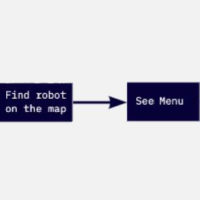

Originally, we wanted to give the user three options after making a payment:
- Going to find the robot
- Having the robot come to them
- Meeting the robot at another location
However, we ultimately decided to scratch option 3 because it added more complexity to the user experience. It would take longer and require more steps and effort from the user. We felt that options 1 and 2 offered a more seamless experience that didn’t require the user to do much after making the purchase.
Day 5 Testing
Findings
On day five, we tested our high-fidelity prototype with users. Here’s what we found:
-
- Users were worried that if the lid opens, people could have access to all the items inside.
- They liked the QR/touchless features.
- Our receipt/QR code page was confusing for some, as they didn’t know how to leave that page.
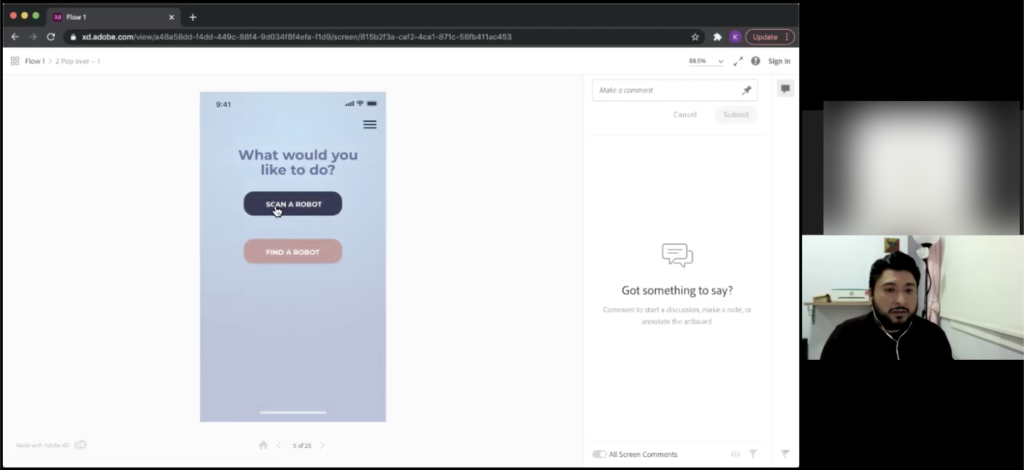
- In the “FIND A ROBOT” option, they weren’t sure what would happen once they placed the order, so we should consider telling them the options of “wait for the robot” or “go find the robot” beforehand.
- I created the name “VENDY” for the machine, but we decided not to use it yet because we wanted to test it with more users.